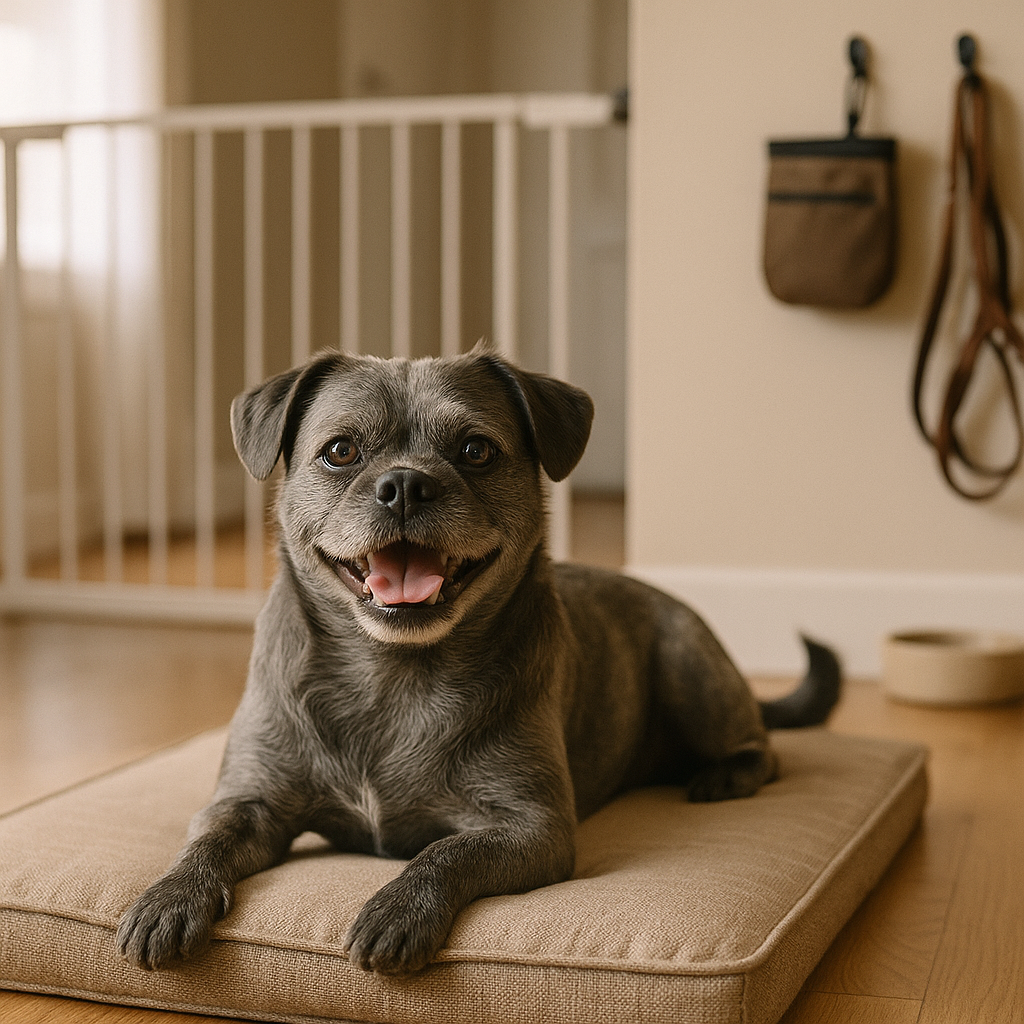
← Back to Start Here: New Dog Journey
The first week is about building a predictable routine so your dog can settle. Your goal is not a “perfect dog” in 7 days, your goal is a dog who feels safe enough to eat, sleep, potty outside, and start learning your household rhythm.
Key takeaways
- Keep life small: routine + rest + short walks + calm enrichment.
- Most “bad behavior” in week one is stress + overstimulation, not stubbornness.
- Practice alone time early (tiny reps) to prevent separation issues later.
- Expect ups and downs. Many dogs need weeks to fully decompress (you’ll cover more in Step 9).
Your goals for Week 1
- Potty routine: your dog learns where to go and what the schedule feels like.
- Sleep + rest: your dog gets enough down time to recover from stress.
- Calm bonding: trust-building without pressure.
- Alone time practice: short, successful reps (seconds → minutes).
- Home management: fewer chances to rehearse chaos (gates, zones, supervision).
A simple daily schedule
Use this as a flexible structure. The exact times don’t matter, consistency does.
Morning
- Potty immediately after waking
- Short sniff walk (10-20 minutes) or backyard sniff time
- Breakfast (bonus points if you hand-feed a portion for calm bonding)
- Rest (crate/pen/quiet zone)
Midday
- Potty
- 5-minute training (name response, touch, sit, or “go to mat”)
- Calm enrichment (lick mat, chew, or simple food puzzle)
- Rest
Afternoon
- Potty
- Short walk (keep it easy; avoid crowded places)
- Rest
Evening
- Potty
- Dinner
- Calm bonding (gentle play, treat toss, brushing if tolerated)
- Settle time (quiet room, low stimulation)
- Final potty before bed
Rest is part of the plan
Many dogs need a lot of sleep, especially in a new environment. Overtired dogs often get mouthy, zoomy, barky, and chaotic. Protect rest like it’s training.
Potty routine (how to get results fast)
- Take out often: after sleep, after eating/drinking, after play, and every 2-4 hours early on.
- Same spot helps: consistency teaches “this is the bathroom.”
- Reward immediately: treat within 1-2 seconds after they finish.
- Supervision: if you can’t watch, use a pen/crate/secured area to prevent hidden accidents.
Common accident causes (Week 1)
- Too much freedom too soon
- Schedule changes (late meals, long errands)
- Stress (new home, new smells, new noises)
- Medical issues (if accidents are sudden or extreme)
If your dog won’t potty outside
- Go to a quiet spot and stand still (don’t wander and talk a lot).
- Give more time (some dogs need minutes, not seconds).
- Try again in 10-15 minutes.
- If no potty happens, supervise closely indoors and try again soon.
Sleep and “settle” (the secret weapon)
Your dog should have a default resting place. This prevents pacing and helps the nervous system calm down.
- Pick a calm zone: crate, pen, or gated room with a bed and water.
- Keep it boring: low noise, low traffic, predictable.
- Reward calm: quietly drop a treat when your dog lies down and relaxes.
Alone time practice (do this on Day 1)
Separation problems are easier to prevent than to fix. Start with tiny reps that your dog can succeed at.
Day 1-2: seconds to 1 minute
- Put your dog in a calm zone with a lick/chew.
- Step out of sight for 5-15 seconds, then return calmly.
- Repeat a few times. End before your dog worries.
Day 3-4: 1 to 5 minutes
- Increase in small jumps: 1 min → 2 min → 3 min → 5 min.
- Keep departures boring (no big goodbye speech).
Day 5-7: short real-life reps
- Do a quick errand if your dog is coping well (start with 5-10 minutes).
- If your dog panics, step back to easier reps and get help early.
Signs you’re going too fast
- Howling, frantic barking, drooling, or destruction when alone
- Trying to escape the crate/pen
- Not touching food/enrichment when you leave
If you see these, slow down and consider professional support. Waiting usually makes it harder.
Outings, visitors, and the “keep life small” rule
Week one is not the time for dog parks, crowded patios, or a parade of visitors. Many dogs are still decompressing, and stress can stack quickly.
- Visitors: keep it minimal; ask people to ignore the dog at first.
- Walks: choose quiet routes; prioritize sniffing over distance.
- New experiences: one small new thing at a time.
Expectation reset
You’ll often hear guidelines like the “3-3-3 rule” for adoption adjustment. It’s not a guarantee, just a reminder that many dogs need days, weeks, and months to fully settle. Step 9 covers this in detail.
What’s normal in Week 1
- Shutdown: quiet, withdrawn, sleepy, lower appetite
- Overstimulation: pacing, whining, barking, zoomies, mouthiness
- Clinginess: following you everywhere
- Minor accidents: common while routines form
When to call the vet or trainer
- Vet: vomiting/diarrhea, not eating for more than 24 hours (or acting unwell), coughing, limping, blood, extreme lethargy
- Trainer/behavior help: escalating growling/snapping, serious resource guarding, panic when alone, reactivity that’s worsening
Gear to consider
Baby gate / playpen: creates calm zones and prevents chaos.
Crate (optional): useful if introduced slowly and positively.
Enzyme cleaner: accidents happen; this prevents repeat potty spots.
Treat pouch + training treats: makes quick training easy.
Lick mat / fillable toy: calm enrichment for alone-time practice.
Harness + leash: safe, predictable walks while your dog adjusts.
Next step
Step 9: The First 30 Days (Decompression + the 3-3-3 Rule).
Last reviewed: January 2026