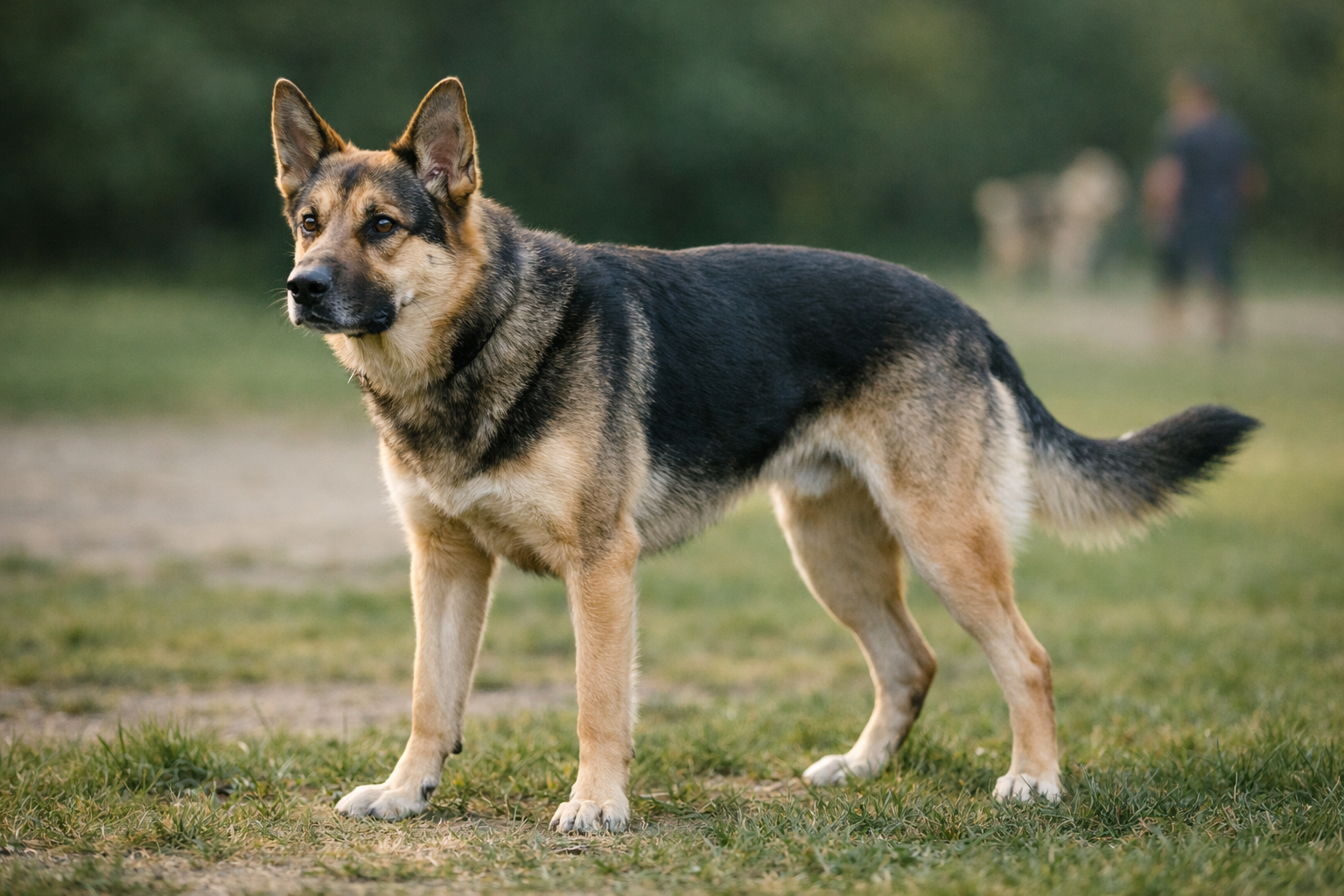
Your dog is standing completely rigid. Their body is tense, their tail is stiff, their movements are jerky. They’re not relaxed, not playful, they look tense, almost like a statue. This is stiff body language, and it’s one of the most important stress signals to recognize.
What Is Stiff Body Language?
Stiff body language is when a dog’s entire body becomes tense and rigid. Instead of the loose, fluid movements of a relaxed dog, you see:
- Stiff legs (like they’re standing on wooden pegs)
- A tense, upright posture
- A rigid tail (held straight out or stiff, not wagging loosely)
- Facial tension (tight mouth, possibly a hard stare)
- Minimal movement or jerky, controlled movements
The whole dog looks like they’re bracing for something. This is fundamentally different from a relaxed, soft body.
What Stiff Body Language Means
A stiff body usually indicates:
- Uncertainty or nervousness
- Discomfort or anxiety
- Readiness to react (either defensively or through flight)
- High arousal in response to a perceived threat
It’s not necessarily aggression, but it’s definitely stress. Your dog’s nervous system is activated, and they’re preparing for something.
Common Situations Where Dogs Stiffen
- Seeing an unfamiliar dog: The stiffness indicates the dog is alert and uncertain about the other dog’s intentions.
- During handling they don’t like: Nail trims, vet exams, being picked up, the stiffness shows discomfort.
- When approached by a stranger: Uncertainty about the person’s intentions.
- When you’re tense or upset: Your dog absorbs your energy and mirrors your tension.
- In new or overwhelming environments: Overstimulation causes the stiffness as the dog assesses the situation.
- Before resource guarding: A stiff dog standing over a toy or food bowl is giving a clear boundary warning.
Stiff Body Language + Other Signals
This is crucial: stiff body language means something different depending on what other signals your dog is showing.
Stiff + whale eye + ears back + tucked tail = Fear or extreme anxiety. Your dog is very uncomfortable.
Stiff + hard stare + forward ears + high tail = Dominance or confrontation. This can be a warning.
Stiff + closed mouth + alert posture = Uncertainty. Your dog is assessing the situation.
Stiff + no other stress signals + playful position = Preparation for play. This is not necessarily bad, your dog might be about to engage playfully.
How to Respond to a Stiff Dog
Pause and assess: Stop whatever you’re doing. Look at the whole dog. What else is your dog showing? Fear? Aggression? Uncertainty?
Create distance if needed: If your dog is stiff and showing other signs of stress, back away. Give them space. Don’t force interaction.
Calm your own energy: If you’re tense or frustrated, your dog will be more tense. Relax your face, breathe, and show your dog that the situation is safe.
Identify the trigger: What made your dog stiffen? Once you know, you can address it.
Avoid forcing the situation: Don’t push your dog into a situation where they’re showing stiff body language. This escalates stress and teaches them that you don’t listen to their warnings.
Stiff Body During Interactions With Other Dogs
If your dog stiffens when meeting other dogs, it’s usually a sign of uncertainty or tension. This is a great moment to:
- Create distance between the dogs
- Work on positive associations with other dogs through desensitization
- Avoid forcing on-leash meetings if your dog consistently stiffens
- Consider consulting with a trainer about dog-to-dog introductions
Stiff Body as a Precursor to Escalation
Here’s the important part: stiff body language is often a precursor to escalation. When you see stiffness, your dog is in a heightened state. If the stressor continues or intensifies, the dog might escalate to growling, snapping, or biting.
Recognizing stiffness early and responding by removing the stressor can prevent escalation entirely.
Key Takeaways
- Stiff body language = tension, uncertainty, or high arousal
- Look at the whole dog, stiffness paired with other signals tells you what your dog is feeling
- Stiffness + fear signals = remove the stressor immediately
- Stiffness + dominance signals = be cautious and create distance
- Don’t force a stiff dog into the situation causing the stiffness
- Stiffness can be a precursor to escalation, address it early
At SnoutHub, we believe a stiff dog is a dog telling you something. Listen early, and you prevent problems. A dog is a bestie.